
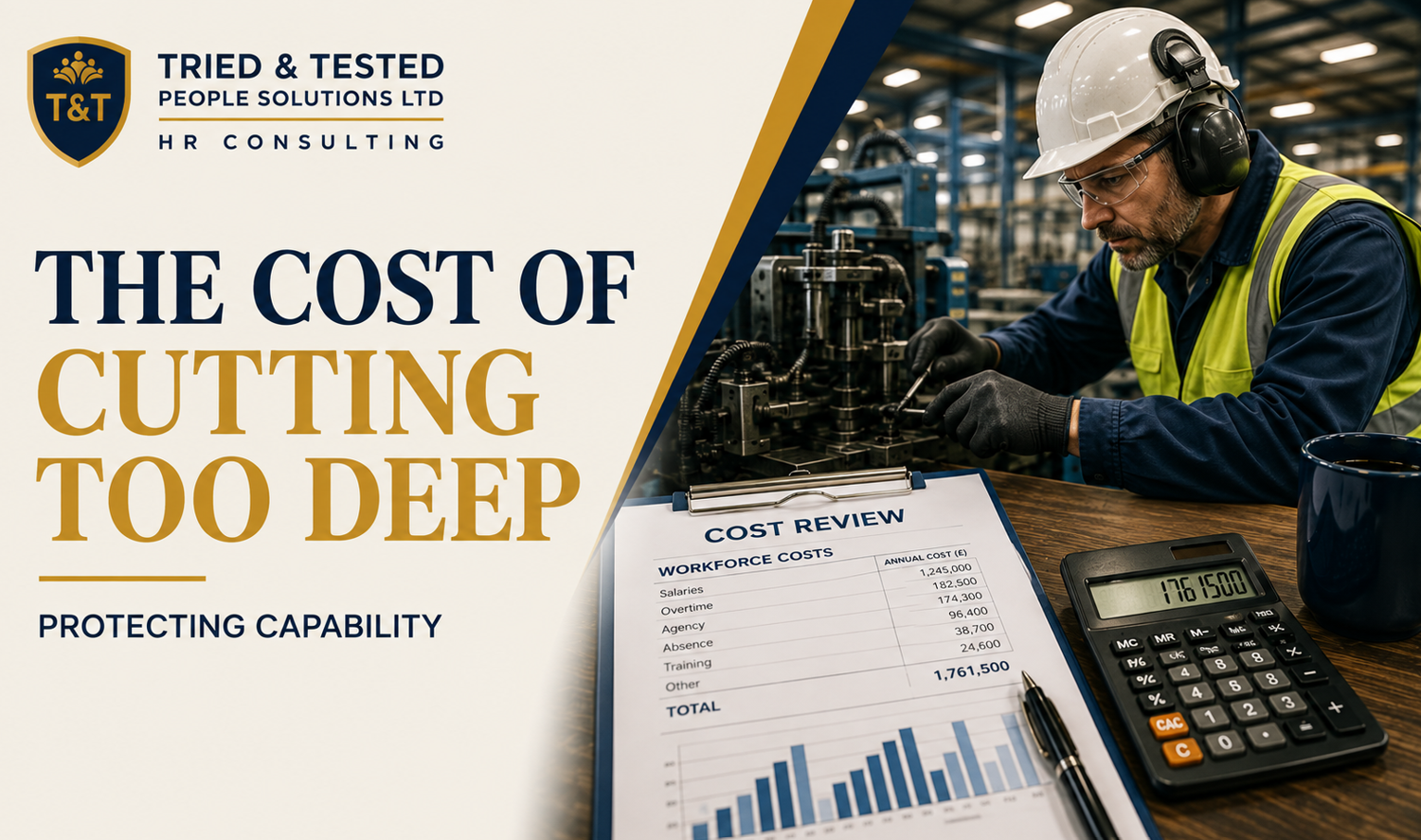
When pressure returns, protecting capability matters
The Cost of Cutting Too Deep
For many businesses, particularly manufacturers, controlling costs has become a constant balancing act. Energy prices, employment costs, materials and wider operating expenses continue to put pressure on margins. When costs rise faster than customers will accept price increases, something has to give.
The natural response is to look for savings.
Vacancies are left unfilled, recruitment is paused, training is postponed, overtime is reduced, development plans are put on hold and sometimes, headcount comes under scrutiny.
Individually, each decision can make perfect commercial sense but the danger comes when short-term cost reduction starts removing capability the business will need later.
Over the last two editions, I’ve talked about preparing for improving economic conditions and looking beyond the search for experienced, ‘oven baked’ employees.
The other side to that conversation is that if skilled people are difficult and expensive to replace, businesses need to be careful about losing the capability they already have.
From the Factory Floor
In manufacturing, a skilled operator may know how to spot a problem before a line stops. An experienced engineer may understand the quirks of equipment that aren’t written in a manual. A good supervisor may know exactly how to get the best from a team during a difficult shift. That knowledge has been built over years.
Remove the role and the salary saving is immediately visible but what is harder to see is the cost of lost knowledge, reduced flexibility, additional pressure on the remaining team and the time required to rebuild that capability when demand increases again.
The cheapest decision today isn’t always the cheapest decision over the next 12 months.
Before You Cut, Look for the Waste
Sometimes the bigger opportunity is understanding where people-related cost is being created unnecessarily.
High sickness absence, repeated recruitment, agency dependency or excessive overtime, poorly managed performance, grievances that drag on, managers spending hours dealing with problems that should have been addressed much earlier.
Across a workforce, these problems can become expensive.
Before reducing investment in people, it is worth asking whether the business is tackling the things already costing money without adding value.
Five Questions to Ask Before Cutting People Costs
1. Which skills would be hardest to replace?
Not every role carries the same workforce risk. Understand where critical knowledge and scarce skills sit before making decisions based purely on cost.
2. What is driving our people costs?
Look beyond payroll. Absence, overtime, agency spend, turnover and poor productivity can all increase the real cost of employing people.
3. Are we solving problems or moving them somewhere else?
Removing a vacancy may reduce one budget but increase overtime, workload or agency costs somewhere else.
4. What happens when demand improves?
If the business needed additional capacity six months from now, how quickly could it respond? Consider what capability would need to be rebuilt and how difficult that would be.
5. Where can we become more productive instead?
Before assuming fewer people is the answer, look at whether better management, clearer accountability, stronger skills or different ways of working could improve performance.
Employment Law Watch
Cost pressures can also increase employment risk.
Changes to structures, roles, working arrangements or headcount need to be handled carefully. Consultation, fair selection processes and appropriate documentation matter, especially where redundancy may be involved.
Good workforce decisions start before the formal process. Understanding what capability the organisation needs, where critical skills sit and what alternatives exist can help employers make better commercial decisions before reaching the point where jobs are at risk.
A Final Thought
Businesses have to control costs.
Sometimes difficult workforce decisions are unavoidable but there is a difference between removing cost and removing capability.
If finding experienced people is already difficult, rebuilding skills and knowledge after they have been lost may prove considerably more expensive than protecting them in the first place.
When every pound is under scrutiny, it is right to ask “Where can we cut?”, but “What can we least afford to lose?” is another question.
0 Comments